U.S. Army Chemical Materials ActivityU.S. Army Chemical Materials ActivityU.S. Army Chemical Materials ActivityU.S. Army Chemical Materials Activity
  • Home
  • About
  • History
  • What We Do
    • Comply
    • Destroy
    • Store
  • Resources
  • Contact

LTC David Dellerman, DrPH

Commander
Blue Grass Chemical Activity

Lieutenant Colonel David A. Dellerman came to the Blue Grass Chemical Activity from Fort Hood, Texas, where he served as Deputy Commander to the 48th Chemical Brigade, 20th Chemical, Biological, Radiological, Nuclear, Explosives (CBRNE) Command. He received his commission in the U.S. Army in May 2005 as a Chemical, Biological, Radiological, and Nuclear (CBRN) Officer. He holds a Doctor of Public Health and a Master of Psychology. His military education includes Pre-Command Course, Command and General Staff College, Defense Support of Civil Authorities Level II Certification, Joint Planners Course, Military Transition Team, Chemical Captains’ Career Course, and the Chemical Basic Officer Course.

LTC Dellerman served in numerous positions, including the Chemical Officer for 6th Battalion, 27th Field Artillery Regiment at Fort Sill, Oklahoma; Chemical Officer for 75th Field Artillery Brigade at Fort Sill; Senior Company Mentor for Military Transition Team, Afghanistan; Team Chief for Military Transition Team, Afghanistan; Company Commander for Wounded Warrior Transition Unit, Joint Base San Antonio, Texas; Small Group Leader for the Chemical Captains’ Career Course at Fort Leonard Wood, Missouri; Chief of Chemical Training Department at Fort Leonard Wood, Missouri; Chief of Security Forces Assistance for 3rd Battalion, 353rd Regiment at Fort Polk, Louisiana; Operations Officer for 3rd Battalion, 353rd Regiment at Fort Polk; Executive Officer for 3rd Battalion, 353rd Regiment at Fort Polk; Senior US and Deputy Chemical Officer for NATO at Joint Forces Command, Naples Italy; Military Assistant for 3-Star NATO General Officer at Joint Forces Command, Naples Italy; Deputy Commander for the 48th Chemical Brigade at Fort Hood, Texas.

His awards and decorations include the Bronze Star, Defense Meritorious Service Medal, Meritorious Service Medal (with three oak leaf cluster), Army Commendation Medal (with three oak leaf clusters), Army Achievement Medal, Army Superior Unit Award, National Defense Service Medal, Afghanistan Campaign Medal (with Arrow Head), Global War on Terrorism Service Medal, Armed Forces Service Medal (with oak leaf cluster), Military Outstanding Volunteer Service Medal, Army Service Ribbon and Army Overseas Service Ribbon (third award), the NATO Medal, and German Armed Proficiency Badge (gold).
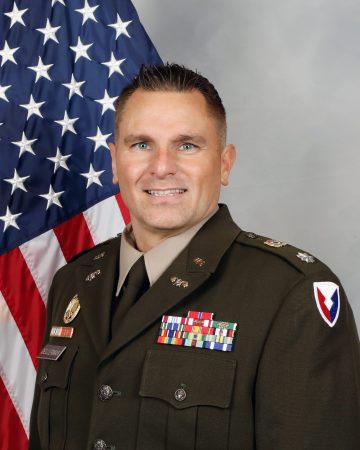
LTC David Dellerman

Commander,
Blue Grass Chemical Activity

Download Biography
Download Photo

CMA Quick Links

  • Homepage
  • About
  • History
  • What We Do
  • Resources
  • Contact

Army Links

  • Army FAQ
  • Spouse Employment Information
  • Accessibility/Section 508
  • Privacy & Security
  • No FEAR Act
  • FOIA
  • AKO
  • Home
  • About
  • History
  • What We Do
    • Comply
    • Destroy
    • Store
  • Resources
  • Contact
U.S. Army Chemical Materials Activity
Mountain

The mountain has been an element that has graced many of the past depot emblems, representing Pike’s Peak.

Missile

The Pershing Missile in the center represents one of the most prominent missions of the depot in the 1980s.

Hawk

The hawk represents native depot wildlife, the present and future mission of the environmental programs, and was also the name of one of the missile systems supplied by the depot during its missile mission in the 1950s and 60s.

Insignias

The branch insignia of both the U.S. Army Chemical Corps and Ordnance Corps represent the depot’s command structure through its history as both an ordnance and a chemical depot.

Colors & Text

The colors cobalt blue and yellow gold are representative of the U.S. Army Chemical Corps. “Pueblo Depot” is representative of the installation throughout its history. “1942” is the date of establishment. “Safety” and “Service” capture the continued and historical depot missions.

Motto

The motto translates to “A Common Good.”

Sun

The rising sun denotes the dawning of a new day without chemical weapons and the organization’s mission to safely destroy chemical weapons stockpile, thus changing the future of modern warfare.

Wheat

The three stalks of wheat symbolize the harvest of hope that has been secured through industry, cultivation and abundance. It also refers to the unit’s chemical/biological, smoke/obscurant and support to Homeland security industrial base missions at Pine Bluff Arsenal.

Eagle

The double-headed eagle suggests the two CMA methods for stockpile chemical weapons disposal, incineration and neutralization. These methods’ roots are traced back to Project Eagle I (incinerating of mustard agents) and Eagle II (neutralizing nerve agents).

Olive Branch

The olive branch signifies peace and the Activity’s commitment to abide by the stipulations of the Chemical Weapons Convention Treaty and assisting other nations.

Octagon

The octagon alludes to the eight original chemical weapons stockpile storage sites in the United States.