RCWM STORAGE
Recovered Chemical Warfare Materiel (RCWM) requires safe and secure storage pending destruction due to their often-deteriorated
conditions. Interim holding facilities (IHF) provide safe, temporary storage for recovered chemical warfare materiel at sites
where storage facilities, such as igloos and bunkers, are unavailable.
Interim Holding Facilities (IHF)
Engineers developed stringent construction and safety requirements for the IHF. The IHF’s design allows for the installation of a
chemical agent filtration system, if necessary. The facilities consist of fireproof and corrosion-resistant materials.
Light switches and fixtures, outlets and air conditioners must meet strict non-explosive design requirements to reduce
the risk of fire inside the IHF. Additionally, the IHF includes a secondary containment area below the floor that would
contain liquids should a leak occur. The IHF includes high-security locks and remains enclosed in a fenced area. Automatic
lights attached to the IHF maximize lighting at night. Additionally, a visual security system and agent monitoring of the
IHF is conducted until the recovered items are removed for treatment.
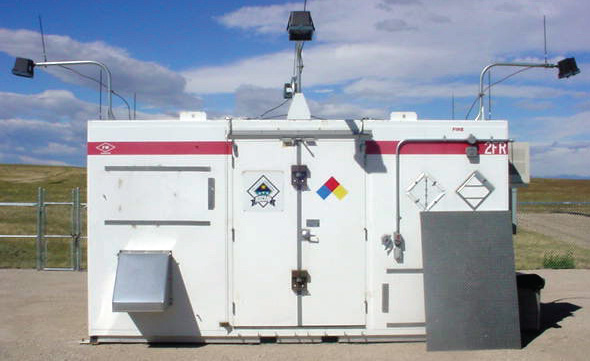
The interim holding facility provides safe storage for recovered chemical warfare materiel until they can be destroyed.
The IHF is equipped with an automatic fire suppression system in compliance with federal hazardous waste management regulations.