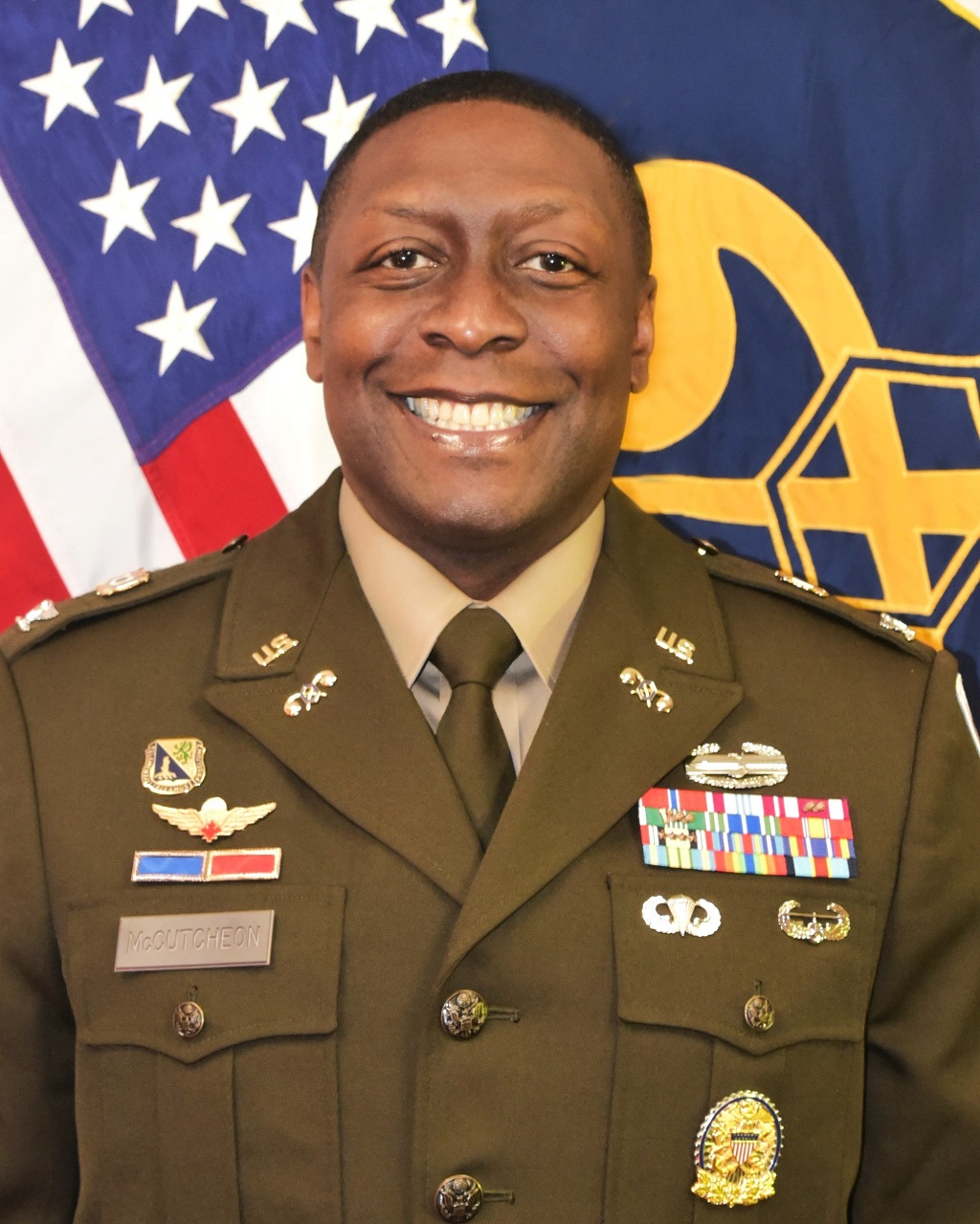
COL Rodney D. McCutcheon
Commander
Redstone Chemical Activity
Colonel Rodney D. McCutcheon assumed command of the Redstone Chemical Activity at Redstone Arsenal in Huntsville, Alabama, on September 13, 2024. The U.S. Army Chemical Materials Activity stood up the RCA in support of the Army’s investigation and remediation of chemical weapons burial sites at the arsenal. The RCA’s four primary areas of responsibility are storage, commodity management, security, and technical expertise.
COL McCutcheon previously served as commander of the U.S. Army Pueblo Chemical Depot, which was deactivated on September 12, 2024, following the completion of the chemical weapons stockpile storage and destruction mission at the depot.
COL McCutcheon enlisted in the South Carolina Army National Guard as a combat engineer in 1996, and trained at Fort Leonard Wood, Missouri. He was assigned to the 122nd Engineer Battalion in South Carolina.
In May 2000, he was commissioned into the Chemical Corps from the Army ROTC program at South Carolina State University, Orangeburg, South Carolina.
COL McCutcheon has earned a Master of Science in Strategic Studies from the U.S. Army War College, Carlisle, Pennsylvania, Master of Science in Environmental Management from Webster University, St. Louis, Missouri, and Bachelor of Science degree in Criminal Justice from South Carolina State University, Orangeburg, South Carolina.
His military education includes the Chemical Officer Basic Course, Chemical Captains Career Course, Basic Airborne Course, Air Assault Course, U.S. Army Command and General Staff College, and the U.S. Army
War College.
COL McCutcheon’s previous assignments include: Heavy Decontamination Platoon Leader, 92nd Chemical Company, Battalion Chemical Officer, 3-69th Armor Battalion, Brigade Chemical Officer, 1st Brigade, 3rd Infantry Division, Fort Stewart, Georgia, 2000-2004; Planner, Chemical Cell, 82nd Airborne Division, Planner, Chemical Cell, 18th Airborne Corps, Chemical Officer, 18th Field Artillery Brigade, Battery Commander, 18th Field Artillery Brigade, Fort Bragg, North Carolina, 2004-2008; Current Operations Officer Deputy Chief of Staff of Operations, U.S. Army Human Resources Command, Alexandria, Virginia, 2008-2010; Fellowship, Dept. of Health and Human Services, Washington D.C., 2010-2011; Chemical Cell Officer, 4th Maneuver Enhancement Brigade, Executive Officer, 193rd Brigade Support Battalion, Executive Officer, 4th Maneuver Enhancement Brigade, Fort Leonard Wood, Missouri, 2011-2015; Planner, Countering Weapons of Mass Destruction Combined Joint Interagency Coordination Group-Korea, 2015-2017; Chief, Chemical Surety Division, Headquarters, U.S. Army Training and Doctrine Command, Fort Eustis, Virginia, 2017-2018; Commander, Blue Grass Chemical Activity, Richmond, Kentucky, 2018-2020; Protection & Chemical, Biological, Radiological, Nuclear and Explosives Chief, XVIII Airborne Corps, Fort Bragg, North Carolina, 2020-2022.
His awards and decorations include: the Bronze Star, Meritorious Service Medal (with three oak leaf clusters), Army Commendation Medal (with V Device), Army Achievement Medal, Presidential Unit Citation, Meritorious Unit Commendation, National Defense Service Medal, Iraqi Campaign Medal (with 4 combat stars), Global War on Terrorism Expeditionary Medal, Global War on Terrorism Service Medal, Korea Defense Service Medal, Military Outstanding Volunteer Service Medal, Army Service Ribbon, Overseas Service Ribbon, and Combat Action Badge.